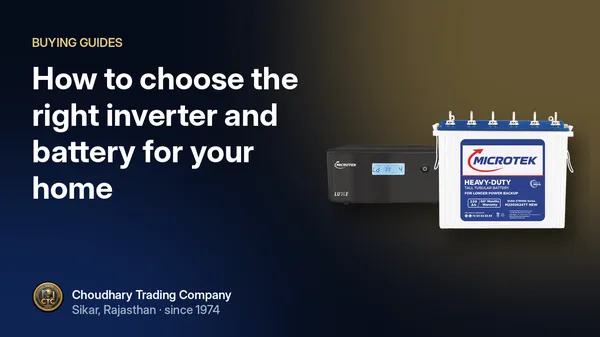
Buying an inverter that is too small means it trips; buying one that is too big wastes money and battery life. Here is the simple method our team uses.
Step 1: List what you want to run during a power cut
| Appliance | Typical watts |
|---|---|
| Ceiling fan | 50–75 W |
| LED tube / bulb | 9–20 W |
| LED TV (32–43") | 50–100 W |
| Wi-Fi router | 10–15 W |
| Desert cooler | 150–250 W |
| Refrigerator | 150–250 W (start-up much higher) |
Step 2: Inverter size (VA)
Add up the watts and divide by 0.8 (the power factor). Example: 4 fans (240 W) + 8 LED lights (100 W) + TV (80 W) + router (15 W) = 435 W → 435 ÷ 0.8 ≈ 545 VA. Choose the next size up with some headroom: an 800–900 VA inverter. If you want to run a cooler or fridge, move up to 1100–1500 VA, and above about 1500 VA choose a 24V model.
Step 3: Battery size (Ah)
Backup hours ≈ (battery Ah × battery voltage × 0.7) ÷ load in watts. For a 12V, 150Ah battery and a 435 W load: 150 × 12 × 0.7 ÷ 435 ≈ 2.9 hours. For 4–5 hours choose 200–220Ah, or a 24V system with two batteries.
Step 4: Pure sine wave or digital?
Pure sine wave inverters give clean power that is better for computers, LED TVs, fans with electronic regulators and fridges, and they run fans more quietly. Digital (modified sine) inverters are cheaper and acceptable for basic lights and fans.
Step 5: Tubular or lithium?
Tall tubular batteries are the value choice. Lithium costs more but recharges much faster, needs no water and lasts longer — read our tubular vs lithium guide.
Prefer not to calculate? Send us your appliance list on WhatsApp and we will recommend the exact combo.